
Source: Baseball America
With the 2025 season in the books and rosters largely settled, it’s time to take an early look at the programs best positioned to make noise in 2026. Returning production, transfer additions and coaching changes all factor heavily into this projection of the top 25 teams heading into next spring.
- UCLA
- LSU
- Texas
- Mississippi State
- Auburn
- Georgia
- Tennessee
- Georgia Tech
- Virginia
- TCU
- Arkansas
- Florida State
- North Carolina
- West Virginia
- Vanderbilt
- Miami
- Oregon State
- Clemson
- Alabama
- Louisville
- Florida
- Arizona State
- Coastal Carolina
- Ole Miss
- Texas A&M
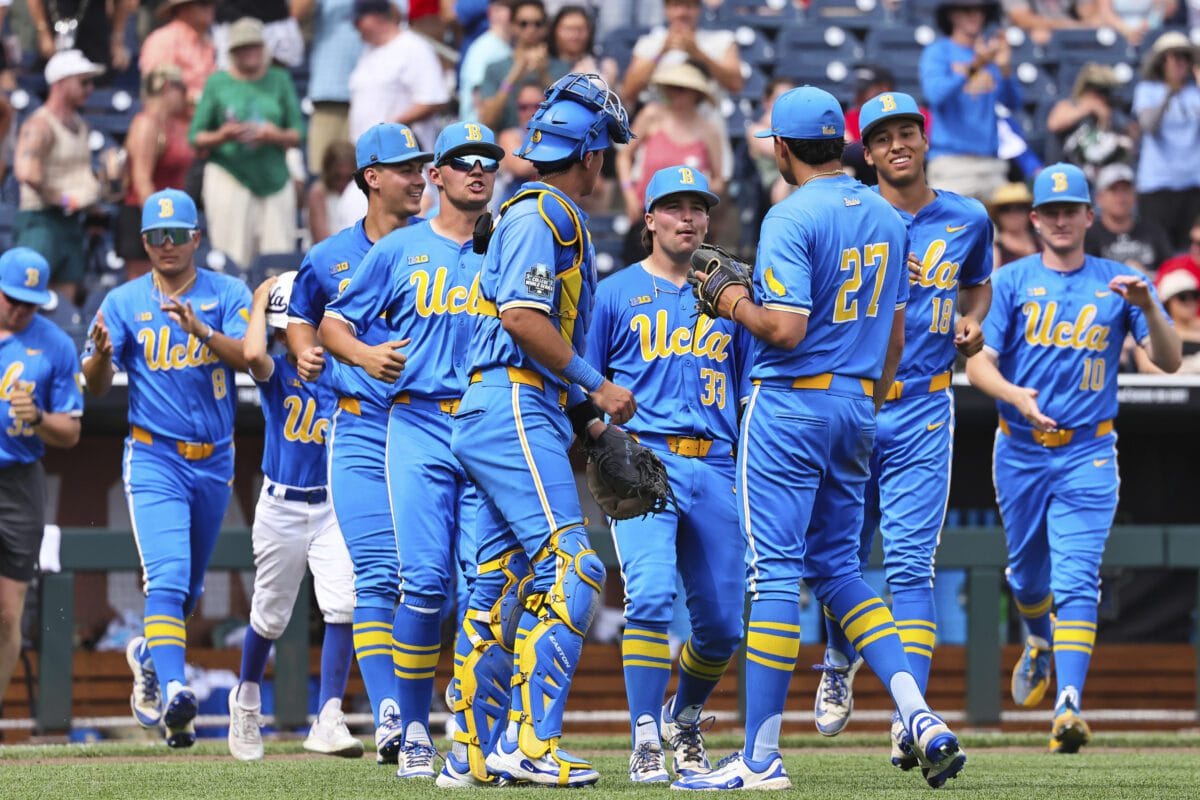
1. UCLA Bruins (48–18, 22–8 Big Ten)
2025: College World Series | Final Ranking: 6
UCLA didn’t need to reinvent itself this offseason—and that’s exactly why the Bruins open at No. 1.
After sharing the Big Ten regular-season title with Oregon and making their first College World Series trip since 2013, UCLA brings back a frightening amount of proven talent. All-America stars Mulivai Levu and Roch Cholowsky return to headline a lineup that loses just one major offensive piece. The weekend rotation stays intact, key bullpen arms are back, and former Texas outfielder Will Gasparino arrives to add more thump and athleticism.
Cholowsky is already on the short list to be the No. 1 overall pick in the 2026 draft, and there may not be a more complete roster in the country. Barring injury, UCLA will spend the entire season with national-title expectations on its shoulders.
2. LSU Tigers (53–15, 19–11 SEC)
2025: National Champions | Final Ranking: 1
LSU claimed its second national title in three years, again showcasing Jay Johnson’s ability to assemble and maximize elite rosters. The Tigers could easily sit atop this list, but the sheer volume of talent lost nudges them just behind UCLA—for now.
The rotation must be rebuilt after the departures of frontline starters Kade Anderson and Anthony Eyanson, and bullpen lynchpin Chase Shores is also gone. Offensively, LSU waves goodbye to several pillars in Jared Jones, Ethan Frey, Daniel Dickinson and Luis Hernandez.
The response? Reload mode. LSU added impact bats like Zach Yorke (Grand Canyon), Trent Caraway (Oregon State) and Seth Dardar (Kansas State), plus high-upside arms Cooper Moore (Kansas), Santiago Garcia (Oregon) and Danny Lachenmayer (North Dakota State).
Given Johnson’s track record, it’s safer to assume LSU will again look like a top-tier Omaha threat than anything else.
3. Texas Longhorns (44–1, 22–8 SEC)
2025: Eliminated in Austin Regional | Final Ranking: 18
Year one of the Jim Schlossnagle era in Austin produced an SEC regular-season championship in Texas’ debut season in the league. The early postseason exit at home stung, but the foundation is strong—and the roster retool was swift.
The Longhorns lose notable pieces like Will Gasparino, Jared Spencer, Jalin Flores, Rylan Galvan and Max Belyeu, yet retain a stabilizing core on the mound and positionally. Veterans Luke Harrison, Ruger Riojas and Max Grubbs anchor the staff alongside Dylan Volantis (BA Freshman of the Year) and Thomas Burns.
On offense, Texas kept key contributors like Adrian Rodriguez and Ethan Mendoza, while adding help from transfers Temo Becerra (Stanford) and Josh Livingston (Wichita State), both of whom bring experience and polish.
With frontline arms, an SEC-tested roster and an elite coaching staff, Texas is built for more than a regional appearance this time around.
4. Mississippi State Bulldogs (36–23, 15–15 SEC)
2025: Eliminated in Tallahassee Regional | Final Ranking: NR
Few programs changed their trajectory more dramatically this offseason than Mississippi State.
The Bulldogs moved on from 2021 national-title coach Chris Lemonis and landed long-time Virginia skipper Brian O’Connor, one of the most respected coaches in the country. With him came high expectations—and a wave of talent.
Transfers with Virginia ties such as Tomas Valincius, Aidan Teel and James Nunnallee join other big additions Vytas Valincius, Tyler Pitzer, Jackson Logan, Maddox Webb and Drew Wyers. Hard-throwing lefty Jack Bauer, who many expected to sign professionally, chose Starkville instead.
Just as important, the Bulldogs convinced cornerstone third baseman Ace Reese to stay, stabilizing the lineup’s centerpiece.
It’s a new era in Starkville, and the roster looks the part. Dropping Mississippi State any lower than No. 4 feels overly cautious.
5. Auburn Tigers (41–20, 17–13 SEC)
2025: Eliminated in Auburn Super Regional | Final Ranking: 10
Auburn went from the bottom of the SEC to back among its heavyweights in a single season, more than doubling its conference win total and reaching a super regional at home.
The Tigers do lose high-impact names like ace Samuel Dutton and outfielder Ike Irish, but the returning core remains sturdy: Chris Rembert, Chase Fralick, Eric Guevara, Bub Terrell, Christian Chatterton and Andreas Alvarez form a strong everyday base.
On the mound, Auburn added Drew Whalen (Western Kentucky), Ethan Harden (Belmont) and Jake Marciano (Virginia Tech). Offensively, Ryan Farber (Texas State), Todd Clay (UAB) and Logan Greggorio (Northern Illinois) deepen the lineup.
Auburn’s 2025 resurgence doesn’t look like a one-off. The Tigers appear well-positioned to remain a serious SEC factor.
6. Georgia Bulldogs (43–17, 18–12 SEC)
2025: Eliminated in Athens Regional | Final Ranking: 20
Two years into the Wes Johnson era, Georgia has 86 wins and an established identity—but also lingering questions, especially on the mound.
Despite a strong 2025 regular season, the Bulldogs again stumbled in the postseason. Pitching inconsistencies were a recurring theme, and the staff became the clear offseason priority.
Georgia responded with a portal haul headlined by Bryce Calloway (New Orleans), Caden Aoki (USC), Lane Pearson (West Georgia) and catcher Jack Arcamone (Richmond)—all players who passed up pro opportunities. Stanford righties Joey Volchko and Matt Scott bring big arms and upside, even if their results have been uneven to date.
The Bulldogs also welcomed back key contributor Tre Phelps, who flirted with the pros.
If Georgia can finally unlock its pitching depth, its path back to Omaha for the first time since 2008 becomes very realistic.
7. Tennessee Volunteers (46–19, 16–14 SEC)
2025: Eliminated in Fayetteville Super Regional | Final Ranking: 12
Tennessee looked poised to chase another national title early in SEC play but faded late, dropping six of its last seven series before bowing out in the Fayetteville Super Regional.
The Volunteers lose several headliners to pro ball, including Liam Doyle, Andrew Fischer, Gavin Kilen and Dean Curley, but Tony Vitello once again leaned on the portal to keep the talent level high. Newcomers Henry Ford, Evan Blanco, Landon Mack, Garrett Wright and Brady Frederick give Tennessee one of the SEC’s deepest incoming classes.
The return of Brandon Arvidson only strengthens an already impressive pitching group. And if recent history is any indication, Tennessee’s offense will reload and produce, regardless of who steps into the lineup.
8. Georgia Tech Yellow Jackets (41–19, 19–11 ACC)
2025: Eliminated in Oxford Regional | Final Ranking: 25
The post–Danny Hall era begins in Atlanta, but continuity is the theme rather than upheaval. Former long-time assistant James Ramsey takes the reins after Hall’s 31-season run, and he inherits a roster ready-made to compete.
The Yellow Jackets return an experienced lineup with Kent Schmidt, Vahn Lackey, Alex Hernandez and Drew Burress, plus rotation and bullpen mainstays Mason Patel, Tate McKee and Cooper McMullen.
Georgia Tech also supplemented that core intelligently through the portal. Shortstop Jarren Advincula and lefthander Dylan Loy are both projected impact pieces who could anchor the lineup and rotation, respectively.
The blend of continuity, experience and talent gives Ramsey a chance to keep Georgia Tech near the top of the ACC from day one.
9. Virginia Cavaliers (32–18, 16–11 ACC)
2025: Missed NCAA Tournament | Final Ranking: NR
On the surface, Virginia missing the NCAA Tournament in 2025 looked like a setback. Underneath, the program was bracing for a major reset—one that arrived when Brian O’Connor departed and Chris Pollard stepped in.
Pollard comes over from Duke with a reputation for doing more with less. Now he has considerably more to work with—and he brought a core of Blue Devils with him. Outfielder AJ Gracia was the top-ranked player in the portal and is a legitimate contender to be the No. 1 pick in the 2026 draft. Two-way standout Kyle Johnson and arms Henry Zatkowski and Max Stammel add instant impact.
Given Pollard’s history of pushing teams deep into June despite resource limitations, this Virginia project has enormous upside. The Cavs are a prime candidate to go from missing the field to threatening Omaha in one year.
10. TCU Horned Frogs (39–20, 19–11 Big 12)
2025: Eliminated in Corvallis Regional | Final Ranking: NR
After a disappointing 2024 that ended without a regional berth, Kirk Saarloos steered TCU back into familiar territory: near the top of the Big 12 and back in the NCAA Tournament mix.
The Horned Frogs lose important pieces in Mason Bixby, Karson Bowen, Kole Klecker and Cohen Feser, but the returning group is formidable. Nolan Traeger, Sawyer Strosnider, Chase Brunson, Noah Franco and Tommy LaPour are all back, with Strosnider and LaPour both coming off All-America seasons.
The roster gets another jolt from transfers Tanner Sagouspe (Cal Poly), Rob Liddington (Incarnate Word) and Walt Quinn (Grand Canyon).
With no clear alpha in the Big 12 race, TCU’s combination of depth and balance makes it a strong contender for both a conference crown and a return to Omaha.
11. Arkansas Razorbacks (50–15, 20–10 SEC)
2025: College World Series | Final Ranking: 3
Arkansas reminded everyone of its staying power in 2025, reaching the College World Series semifinals and reasserting itself among the sport’s elites. Now comes the hard part: replacing almost everything.
The draft gutted the roster. Gage Wood, Wehiwa Aloy, Zach Root, Charles Davalan, Christian Foutch, Aiden Jimenez, Landon Beidelschies, Brent Iredale, Ben Bybee, Justin Thomas and Parker Coil all moved on, taking with them the weekend rotation, most of the bullpen, a Golden Spikes–level shortstop and key bats throughout the order.
Arkansas responded by stacking an impressive transfer class—Ethan McElvain, Maika Niu, Zack Stewart and Jackson Kircher headlining the group—and leaning on returning slugger Kuhio Aloy. On the mound, Gabe Gaeckle steps into the spotlight in his draft year.
This will look like a very different Razorbacks team, but Dave Van Horn’s track record makes it hard to drop them too far.
12. Florida State Seminoles (42–16, 17–10 ACC)
2025: Eliminated in Corvallis Super Regional | Final Ranking: 11
If Arkansas took a hit from the draft, Florida State got rocked just as hard. The Seminoles matched the Razorbacks with 11 players selected, including stars Jamie Arnold, Alex Lodise, Cam Leiter, Max Williams, Drew Faurot, Peyton Prescott, Joey Volini, Evan Chrest, Gage Harrelson, Jaxson West and Maison Martinez.
That haul represents most of the lineup, a large chunk of the rotation and several key bullpen pieces. The 2026 roster will have a very different look.
Florida State’s staff responded by leaning into the portal, with former FAU lefthander Trey Beard serving as a headliner. Many of the additions will be stepping up in competition, making this one of the more volatile rosters in the top 25.
Still, Link Jarrett has stabilized the program and restored national relevance. Navigating this much turnover may be his toughest test yet.
13. North Carolina Tar Heels (46–15, 18–11 ACC)
2025: Eliminated in Chapel Hill Super Regional | Final Ranking: 9
North Carolina came within one win of making back-to-back trips to Omaha and reached its third super regional in four years under Scott Forbes.
There’s plenty of production to replace, but the Tar Heels have a clear offensive anchor in Gavin Gallaher, whose 68 RBIs led the team last spring. The transfer quartet of Owen Hull, Erik Paulsen, Jake Schaffner and Macon Winslow should give the lineup a needed injection of experience and power.
On the mound, UNC must replace ace Jake Knapp (14–0, 2.02 ERA), but the projected rotation of Jason DeCaro, Ryan Lynch and Walker McDuffie has the potential to be one of the best in the ACC.
UNC has lived on the doorstep of Omaha. The 2026 group has the pieces to push that door open.
14. West Virginia Mountaineers (44–16, 19–9 Big 12)
2025: Eliminated in Baton Rouge Super Regional | Final Ranking: 13
The Steve Sabins era in Morgantown is off to a flying start. In year one, West Virginia reached a second straight super regional and firmly established itself as a consistent threat in the Big 12.
There’s experience to replace on both sides of the ball, but the Mountaineers return a compelling core. Sophomore Gavin Kelly will be a focal point of the offense, while live-armed righty Chase Meyer is a strong candidate to grab the Friday-night role after primarily working in relief.
Division II standout Dawson Montesa is expected to join the weekend rotation, and lefty Andrew Middleton is one of the biggest wild cards in the portal class—29 strikeouts in 11.2 innings scream upside if health cooperates.
WVU might not be the flashiest brand, but the trajectory under Sabins is undeniably upward.
15. Vanderbilt Commodores (43–18, 19–11 SEC)
2025: Eliminated in Nashville Regional | Final Ranking: 17
Vanderbilt entered the 2025 tournament as the No. 1 overall seed, only to see its season end at home against No. 4 seed Wright State. That disappointment doesn’t change the larger picture: the Commodores still live in the “reload, not rebuild” tier of college baseball.
They lose important pieces on both sides of the ball, particularly in the rotation, but have a strong foundation with pitchers Connor Fennell and Austin Nye, plus position players Brodie Johnston and Braden Holcomb.
In the portal, Vanderbilt took a “quality over quantity” approach. Carter and Logan Johnstone are both high-impact additions. Shortstop Ryker Waite—who barely saw the field as a freshman but earned Cape Cod League all-star honors—could be the next breakout name in Nashville.
The top-end talent is there once again. Expect Vanderbilt to be in the SEC and national mix as usual.
16. Miami Hurricanes (35–27, 15–14 ACC)
2025: Eliminated in Louisville Super Regional | Final Ranking: 16
Miami’s 2025 season looked lost in early April before the Hurricanes flipped the script, played their way into the field and reached their first super regional since 2016.
The 2026 roster will look different, but the program has a clear headliner: Daniel Cuvet, a first-team All-American with some of the loudest power in the country. He’ll again anchor the offense, joined by veteran infielder Jake Ogden, who opted to pass on the draft and return.
Transfers Vance Sheahan, Alex Sosa and Brylan West bring more middle-of-the-order punch, while AJ Ciscar and Tate DeRias are poised to take on full-time weekend roles after promising freshman seasons.
Between an impressive transfer class and a strong core of returners, Miami looks more like a program re-establishing its standard than one riding a one-year surge.
17. Oregon State Beavers (48–16–1 Independent)
2025: College World Series | Final Ranking: 5
Oregon State made its first trip to Omaha since 2018 in 2025, and the Beavers will try to ride that momentum into 2026 with a profile that looks very different: pitching-first.
The lineup was hit hard by departures, and several bats will need to step into significantly bigger roles. The pitching staff, however, has the potential to be one of the nation’s best.
Righty Dax Whitney emerged as the top freshman arm in the country last season, while lefty Ethan Kleinschmit impressed in his first Division I campaign. Behind them is a deep bullpen with multiple arms capable of handling leverage innings.
The Beavers might not bludgeon opponents, but they’re built to win low-scoring, tight postseason games—exactly the kind that decide Omaha runs.
18. Clemson Tigers (45–18, 18–12 ACC)
2025: Eliminated in Clemson Regional | Final Ranking: 24
Clemson has rattled off three straight 40-win seasons but hasn’t been able to break through to Omaha, with each of the last three campaigns ending at home.
Center fielder Cam Cannarella was the heart of the program for three years and leaves a huge void, but Clemson has both a solid returning group and an exciting transfer influx. Jarren Purify and Tryston McCladdie return to the lineup, while Ty Dalley, Tyler Lichtenberger and Nate Savoie project as middle-of-the-order additions via the portal.
On the mound, righty Aidan Knaak again leads the way, and lefty Talan Bell looks ready for a breakout after flashing his potential in a limited freshman workload. Joe Allen, Justin LeGuernic and Drew Titsworth will all carry significant innings in some capacity.
The Tigers haven’t reached Omaha since 2010, but the 2026 team has enough upside to at least make that conversation interesting.
19. Alabama Crimson Tide (41–18, 16–14 SEC)
2025: Eliminated in Hattiesburg Regional | Final Ranking: NR
In just two seasons, Rob Vaughn has taken Alabama to regionals twice and built the Crimson Tide into a program that feels like a consistent SEC nuisance with real upside.
Shortstop Justin Lebron emerged as a star in 2025 and could hear his name called in the top 10 picks next summer. He’ll be the centerpiece of an offense that also welcomes transfers Sam Christiansen, Logen Devenport, John Lemm and Justin Osterhouse, all of whom bring serious power potential.
On the mound, Alabama must replace rotation anchor Riley Quick, opening the door for lefty Zane Adams to slide into the Friday spot. Fellow southpaw Matthew Heiberger and multiple transfer arms give the Tide several options to round out the weekend rotation.
Rather than taking a step back, Alabama looks ready to keep pushing toward its first College World Series appearance of this century.
20. Louisville Cardinals (42–24, 15–15 ACC)
2025: College World Series | Final Ranking: 4
Louisville went from back-to-back seasons without a regional to a return trip to Omaha in 2025, its first College World Series appearance since 2019. That kind of jump doesn’t happen by accident.
The 2026 roster has similar upside. Offensively, the Cardinals can lean on a strong core in Alex Alicea, Tague Davis, Lucas Moore and Zion Rose. On the mound, multiple key arms return to form the backbone of a staff that proved postseason-ready.
Louisville didn’t blitz the portal, mostly because it didn’t have to. Ben Slanker (Ohio), a 21-homer slugger, should slot into a corner outfield spot, while Jacob Bean (Kent State) is expected to compete for a weekend rotation role.
If the development curve continues under Dan McDonnell, Louisville has a legitimate chance to string together multiple deep postseason runs.
21. Florida Gators (39–22, 15–15 SEC)
2025: Eliminated in Conway Regional | Final Ranking: 23
Florida looked destined to miss the NCAA Tournament in early April before flipping its season with a pivotal sweep of Missouri, then ripping off six straight SEC series wins to charge into the field.
The goal for 2026 is to avoid such a narrow path—and Kevin O’Sullivan has the personnel to do it. Sophomore Brendan Lawson is already tracking as a potential No. 1 overall pick in 2027, while Blake Cyr, Hayden Yost, and a healthy Kyle Jones and Cade Kurland give the Gators a loaded returning group.
Columbia standout Sam Miller should quickly carve out an everyday role, and former Jacksonville outfielder Jaden Bastian brings plus defense in center and a top-of-the-order profile.
On the mound, the duo of Liam Peterson and Aidan King is an excellent starting point. Options like Luke McNeillie, Jackson Barberi and UCF transfer Russell Sandefer give Florida flexibility in shaping its weekend staff.
Florida’s talent base once again looks like that of a team capable of making regular Omaha appearances.
22. Arizona State Sun Devils (36–24, 18–12 Big 12)
2025: Eliminated in Los Angeles Regional | Final Ranking: NR
Arizona State finally got back into the NCAA Tournament in 2025—its first trip since 2021—and even notched a win over UC Irvine before bowing out. That breakthrough came despite a roster that would soon be thinned by the draft.
The Sun Devils lost nine players to pro ball, their most selections since 1981. Still, Willie Bloomquist and his staff pieced together a productive offseason.
Returners Landon Hairston and Beckett Zavorek headline the position group, with Zavorek turning heads with a big summer in the Northwoods League. Former Cal shortstop P.J. Moutzouridis brings plus defense to the left side, while Dean Toigo and Dominic Longo add more offensive punch.
On the mound, lefty Cole Carlon is the favorite to take over Friday-night duties. Behind him, there’s enough depth to construct a solid rotation and bullpen.
Arizona State not only has the pieces to return to the tournament, but also the potential to host a regional for the first time in several years.
23. Coastal Carolina Chanticleers (56–13, 26–4 Sun Belt)
2025: College World Series Finalist | Final Ranking: 2
Few programs had a more magical 2025 than Coastal Carolina. The Chanticleers surged all the way to the College World Series final for the first time since their 2016 national championship, setting numerous program records in the process and netting first-year head coach Kevin Schnall national Coach of the Year honors.
Replicating that run won’t be easy, but the building blocks are there. The pitching staff will again be a strength, led by potential first-rounder Cameron Flukey and supported by an exciting group of returners: Dominick Carbone, Scott Doran, Hayden Johnson, Luke Jones and Ryan Lynch.
The lineup has more question marks, but table-setter Dean Mihos returns, and transfers Lukas Buckner, Cole Chamberlain and Jordan Taylor should step right into key roles.
Coastal may not start 2026 as a trendy national-title pick, but another deep postseason run is firmly on the table.
24. Ole Miss Rebels (43–21, 16–14 SEC)
2025: Eliminated in Oxford Regional | Final Ranking: 19
After missing regionals in both 2023 and 2024, Ole Miss entered 2025 under intense scrutiny. The Rebels quieted the noise by winning 43 games, hosting a regional and looking much more like the program that claimed a national title earlier in the decade.
They now move forward without their two leading hitters, Luke Hill and Mitchell Sanford, but the cupboard is far from bare. The Rebels return significant production in Judd Utermark, Austin Fawley, Will Furniss and Hayden Federico.
Portal additions Daniel Pacella (Illinois State), who slugged his way to a .714 slugging percentage with 39 extra-base hits, and Dom Decker (Murray State), a high-OBP bat, give the offense real teeth.
On the mound, lefty Hunter Elliott—fresh off a bounce-back season—returns as the rotation anchor. Owen Kelly, Grant Richardson, Cade Townsend and others will battle for the remaining weekend spots.
Ole Miss’ 2025 performance looked far more like the real version of the program—and 2026 should reinforce that.
25. Texas A&M Aggies (30–26, 11–19 SEC)
2025: Missed NCAA Tournament | Final Ranking: NR
Texas A&M’s 2025 campaign was a shock. The Aggies entered as the preseason No. 1 and national-title favorite, only to see their year unravel and culminate in just their second missed tournament since 2006.
That sets up 2026 as a make-or-break type of season in College Station.
The good news: the talent is still there. Dynamic duo Gavin Grahovac and Caden Sorrell combined for only 117 at-bats due to injuries but both have first-round potential and will be focal points of the lineup if healthy. Terrence Kiel II flashed exciting tools as a freshman, while Bear Harrison and Sawyer Farr return as key contributors.
Landing star infielder Chris Hacopian through the portal was one of the biggest pickups of the offseason, and he could easily lead the team in multiple offensive categories. Outfielders Jake Duer and Wesley Jordan should also play major roles. On the mound, Carson Bailey, M.J. Bollinger and Ethan Darden are expected to be central pieces.
For Michael Earley and his staff, 2026 is about resetting the standard and proving 2025 was the outlier—not the new norm.