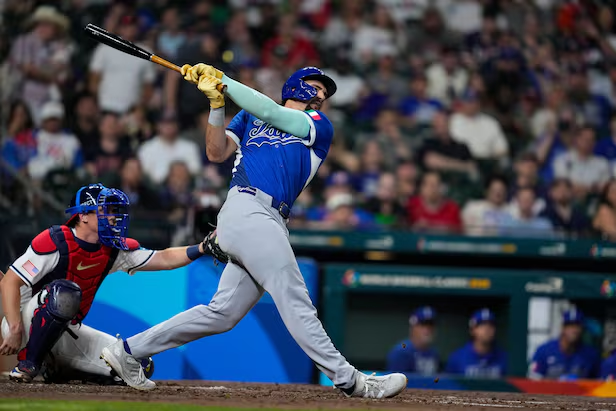


The honkbal hoofdklasse, the top professional baseball league in the Netherlands, will implement a significant structural change starting with the 2026 season. While the total weekly workload may appear similar on paper, the way innings are distributed will fundamentally alter how teams manage pitching staffs, set rotations, and approach in-game strategy.
This is not a cosmetic adjustment. It is a change that will directly influence competitive balance, roster construction, and weekly preparation.
The Previous Format: Three Full Nine-Inning Games
Until the end of the 2025 season, the honkbal hoofdklasse followed a consistent and predictable weekly schedule:
- Thursday night: 1 game, 9 innings
- Saturday: 1 daytime game, 9 innings
- Sunday: 1 game, 9 innings
This format favored traditional pitching usage. Most teams operated with:
- three fixed starting pitchers per week,
- clearly defined bullpen roles,
- and enough recovery time for relievers between appearances.
Game planning was straightforward, and rotation stability was rarely disrupted.
The New 2026 Format: Saturday Doubleheader
Beginning in 2026, the weekly structure shifts as follows:
- Thursday night: 1 game, 9 innings (unchanged)
- Saturday:Doubleheader
- Game 1: 7 innings
- Game 2: 9 innings
- Exception: if Game 1 goes to extra innings, Game 2 becomes a 7-inning game
Sunday games are removed, concentrating the competitive load into Thursday and a single, demanding Saturday.
Impact on Pitching Rotations: Fewer Traditional Starters
Rethinking the weekly rotation
Under the old system, teams could comfortably line up three starters every week. In 2026, that model becomes less efficient.
Most clubs are likely to:
- reserve their top starter for the Thursday night 9-inning game,
- assign another starter to the 9-inning game in the doubleheader,
- and approach the 7-inning opener with more flexibility.
That first Saturday game is ideally suited for:
- a starter limited to 3–4 innings,
- a planned bullpen game,
- or a swingman who can bridge multiple innings.
For teams without deep rotations, this flexibility is no longer optional, it is essential.
Extra Innings Rule Forces Real-Time Strategy Changes
The rule linking extra innings in Game 1 to the length of Game 2 has major tactical implications.
Managers must now think two games ahead while still in the early innings of the opener.
In practical terms:
- starters may be pulled later than usual in Game 1,
- high-leverage relievers might be avoided unless absolutely necessary,
- preserving arms for Game 2 becomes a constant consideration.
Winning the first game at the cost of exhausting the bullpen could directly compromise the second.
Bullpen Management Becomes the Competitive Divider
Increased reliance on relief depth
Even though total innings per week decrease slightly, bullpen stress increases due to:
- two games played on the same day,
- limited recovery windows,
- and more frequent multi-inning relief appearances.
Teams with:
- multiple relievers capable of throwing 2–3 innings,
- durable arms with quick recovery profiles,
gain a tangible advantage over clubs built around one-inning specialists.
Tactical Effects on Managers and Rosters
Seven-inning games demand urgency
In a shortened game, every inning carries more weight. As a result:
- pinch-hitting decisions will come earlier,
- platoon matchups will be emphasized,
- conservative game management becomes less viable.
There is less room to “wait for the late innings” when the game is already half over by the fourth.
Roster construction will evolve
Expect teams to:
- carry more pitchers overall,
- reduce reliance on classic five- or six-inning starters,
- tailor conditioning programs to shorter, higher-intensity workloads.
Well-organized clubs with strong internal development systems are likely to adapt fastest.
A Structural Shift, Not a Simple Shortening
The Hoofdklasse honkbal 2026 schedule change is about giving players a day-off, as most if not all players work regular jobs during the week, and have to combine their passion for the sport with work and family. With that comes a new type of play less dependend on traditional rotation strength and more on:
- bullpen depth,
- adaptability,
- and managerial decision-making under compressed conditions.
Teams that understand and embrace these dynamics early will gain a measurable edge. The Hoofdklasse honkbal of 2026 will reward precision, preparation, and flexibility more than ever before.