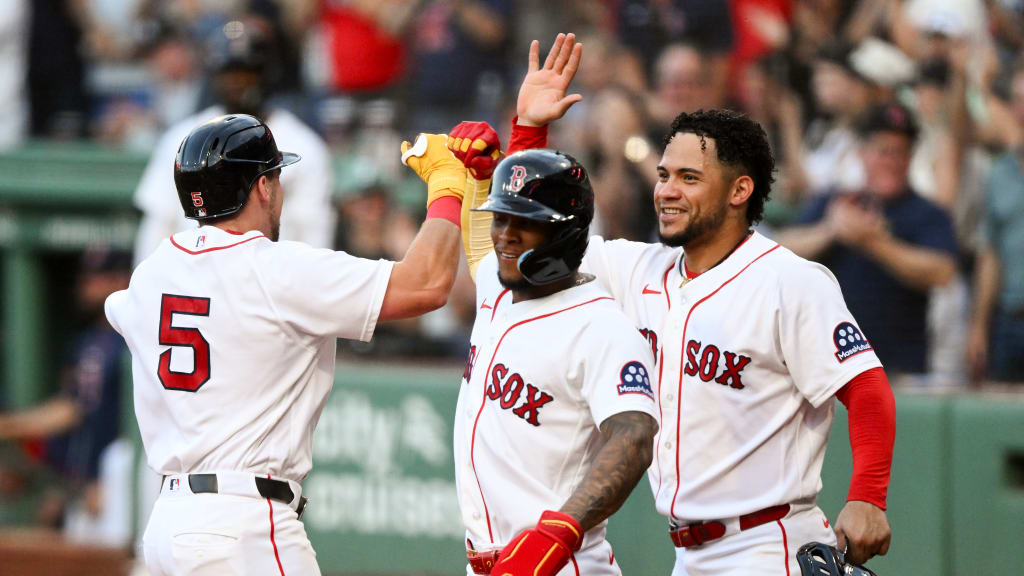

The Boston Red Sox have completely changed the direction of their 2026 season.
A team that looked in serious danger of falling out of contention before the All-Star break has suddenly become one of the hottest clubs in Major League Baseball. Entering August 10, Boston sits at 64-53 after producing a remarkable 32-7 stretch since June 25, turning what once looked like a lost season into a legitimate postseason campaign.
The Red Sox are currently third in the American League East, but their position in the Wild Card race is considerably stronger. More importantly, the way Boston has been winning suggests this is not simply a short-term hot streak.
The offense has become deeper, the pitching staff has stabilized, and several players are producing at an All-Star level at exactly the right time.
Two consecutive losses to the Athletics over the weekend slowed Boston's momentum slightly, but they hardly changed the broader picture. Before those defeats, the Red Sox had won nine consecutive games. Earlier in the summer, they put together an even more impressive 15-game winning streak.
Boston has become one of the most dangerous teams in the American League.
Red Sox Have Gone 32-7 Since June 25
Boston's turnaround began on June 25.
At that point, the Red Sox were 32-46 and appeared more likely to become sellers than contenders. Since then, they have gone 32-7.
That represents an extraordinary .821 winning percentage over a 39-game stretch.
Even more impressive is how decisively Boston has been beating opponents.
During those 39 games, the Red Sox scored 216 runs while allowing only 125. That is a plus-91 run differential, with Boston averaging approximately 5.54 runs per game while allowing only 3.21.
Those numbers matter.
Teams can occasionally produce long winning stretches through close games, bullpen luck or unusually strong situational hitting. Boston's run has been different. The Red Sox have consistently outscored opponents by significant margins while receiving contributions from both the offense and pitching staff.
Their overall season run differential now sits at plus-84.
That is a dramatic shift for a team that spent much of the opening months trying to climb back toward .500.
July was particularly dominant. Boston went 21-4 during the month, including its 15-game winning streak, and effectively forced itself back into the postseason conversation.
By the Trade Deadline, the question was no longer whether Boston should sell.
The Red Sox had become buyers.
Willson Contreras Has Been Boston's Offensive Leader
Willson Contreras has been at the center of Boston's offensive success.
Through 107 games, Contreras is batting .285 with a .394 on-base percentage and .533 slugging percentage. His .927 OPS is among the best marks on the roster.
He has also produced 23 home runs and 70 RBIs.
Contreras currently leads Boston in several major offensive categories, including batting average, home runs, RBIs and on-base percentage.
The most valuable part of his performance has been his consistency.
Contreras gives Boston a middle-of-the-order hitter capable of generating power while also controlling the strike zone. His ability to draw walks prevents opposing pitchers from simply working around the dangerous hitters surrounding him.
For a lineup that has increasingly become difficult to navigate from top to bottom, Contreras has been the anchor.
Ceddanne Rafaela Has Developed Into a Complete Star
Ceddanne Rafaela's development has been another major reason for Boston's rise.
Rafaela is hitting .284 with a .787 OPS, 15 home runs, 60 RBIs and 16 stolen bases. His 126 hits lead the team.
His offensive production alone would make him an important part of Boston's lineup, but Rafaela's overall value extends far beyond his bat.
His defense, speed and versatility make him one of the most complete players on the roster.
After entering the major leagues with questions about his offensive consistency, Rafaela has gradually become a player capable of impacting games in nearly every possible way.
His combination of contact ability, extra-base power, baserunning and premium defense has made him one of Boston's most valuable players in 2026.
If the Red Sox are playing postseason baseball in October, Rafaela could be one of the players most capable of changing a game without necessarily hitting a home run.
Wilyer Abreu Continues to Provide Important Power
Wilyer Abreu has also become a major part of Boston's offensive identity.
Abreu is batting .255 with a .330 on-base percentage and .460 slugging percentage. He has produced 20 home runs and 63 RBIs while drawing 50 walks.
His left-handed power gives Boston an important weapon against right-handed pitching, particularly at Fenway Park.
During Boston's extended surge, Abreu has been especially productive. He hit 10 home runs with 24 RBIs during a 37-game stretch leading into the second week of August.
That kind of production has helped prevent opposing teams from pitching around Contreras or focusing exclusively on the top of Boston's lineup.
Caleb Durbin has provided additional depth, hitting .251 with 11 home runs, 54 RBIs and 14 stolen bases.
Boston's offensive strength is no longer dependent on one or two hitters carrying the lineup.
That depth could become increasingly important during the final weeks of the regular season.
Sonny Gray Has Become the Rotation's Stabilizer
Boston's pitching turnaround has been just as important as its offensive improvement.
Despite operating without injured ace Garrett Crochet for a significant portion of the season, the Red Sox pitching staff has performed at a high level.
The team owns a 3.50 ERA and 1.22 WHIP through 117 games.
Sonny Gray has been the most reliable starter.
Gray is 14-2 with a 2.78 ERA and 1.15 WHIP across 119⅔ innings. He has recorded 14 quality starts in 21 appearances while allowing only 12 home runs.
His performance has given Boston exactly what it needed while Crochet has been unavailable: a veteran starter capable of delivering six or seven competitive innings almost every time through the rotation.
Gray's value could become even greater during the postseason.
A starter with his experience, command and ability to limit damage gives Boston someone capable of handling Game 1 or Game 2 responsibilities in a playoff series.
Payton Tolle Gives Boston a High-Upside Second Option
Payton Tolle has emerged as another important part of the rotation.
Tolle is 7-6 with a 3.20 ERA and 1.10 WHIP over 107 innings. His 124 strikeouts lead the team.
That works out to more than 10 strikeouts per nine innings.
His ability to miss bats gives Boston a different type of weapon than Gray.
In postseason baseball, strikeout pitchers become particularly valuable because they can escape high-leverage situations without relying on defense.
Ranger Suárez has also provided stability with a 3.32 ERA across 103 innings, while Connelly Early has posted a 3.44 ERA over 91⅔ innings.
Boston may not currently possess the deepest rotation in baseball, but it has enough quality options to remain competitive in virtually every series.
Aroldis Chapman and Garrett Whitlock Give Boston a Strong Late-Inning Formula
Boston's bullpen has also developed a clear structure.
Aroldis Chapman has converted 27 saves while posting a 2.04 ERA with 50 strikeouts in 39⅔ innings.
The veteran left-hander remains extremely difficult to handle when his command is working.
Garrett Whitlock has been just as valuable in front of him.
Whitlock owns a 2.05 ERA and 0.89 WHIP across 44 innings while recording 21 holds.
Together, Whitlock and Chapman give Boston a reliable late-game combination.
That becomes increasingly important during the postseason, when managers are far more aggressive about shortening games.
If Boston can consistently take a lead into the seventh inning, its chances of protecting that advantage are considerably stronger than they were earlier in the season.
Adley Rutschman Could Make Boston Even Better
Perhaps the most interesting part of Boston's recent success is that one of its biggest additions has barely contributed yet.
The Red Sox acquired catcher Adley Rutschman from Baltimore before the Trade Deadline while he was recovering from left wrist inflammation.
Before the injury, Rutschman was batting .251 with eight home runs and 47 RBIs in 67 games.
He has since begun a Minor League rehabilitation assignment and could make his Red Sox debut during the club's series in Toronto.
Rutschman's arrival could significantly strengthen an already dangerous lineup.
The switch-hitting catcher gives Boston another disciplined hitter capable of reaching base, driving the ball and extending innings.
His impact could also extend to the pitching staff.
Catching becomes increasingly important late in the season when teams rely heavily on scouting reports, bullpen matchups and game planning. Rutschman's experience could provide Boston with additional stability behind the plate.
The Red Sox managed to produce their 32-7 run largely without him.
Adding a healthy Rutschman could therefore raise the team's ceiling even further.
Roman Anthony and Garrett Crochet Remain Potential Wild Cards
Boston could receive additional reinforcements before the regular season ends.
Roman Anthony has progressed in his recovery from a hand injury and has resumed baseball activities.
His return would add another high-upside bat to the lineup.
Garrett Crochet remains the more uncertain situation.
The left-hander has resumed throwing, but Boston cannot simply assume he will return to full starting-pitcher form before October.
If Crochet does return, however, the implications would be significant.
A postseason rotation featuring Crochet, Gray and Tolle would suddenly look considerably more dangerous.
Boston should not need Crochet to reach the playoffs.
But getting him back could dramatically improve its chances of advancing once it gets there.
Remaining Schedule Gives Boston a Realistic Path to 90 Wins
The Red Sox have 45 games remaining.
At 64-53, they would need to go 26-19 over the rest of the regular season to finish with 90 victories.
A 28-17 finish would give Boston 92 wins.
Neither scenario requires the Red Sox to maintain anything close to their current .821 pace.
That is one of the biggest reasons for optimism.
Boston has already done the hardest part by recovering from its 32-46 start. The team no longer needs to play historically dominant baseball simply to remain in contention.
It now needs to play solid winning baseball.
The immediate schedule includes four games against Toronto, followed by series against Pittsburgh and Arizona.
The Red Sox also have several important divisional matchups remaining, including four games at Yankee Stadium and four games in Baltimore.
Those games could significantly influence both the AL East standings and Wild Card positioning.
Boston still has 15 games remaining against AL East opponents.
That creates both opportunity and risk.
A strong divisional finish could allow the Red Sox to pressure the teams above them. A poor stretch could quickly reduce their Wild Card cushion.
Can Boston Still Win the AL East?
Winning the division remains possible, but it will be difficult.
Boston enters August 10 seven games behind first-place Tampa Bay and 2½ games behind the Yankees.
With only 45 games remaining, seven games is a meaningful deficit.
The Red Sox would likely need to remain one of baseball's best teams through September while also getting significant help from Tampa Bay.
The more realistic objective is securing a Wild Card berth.
Boston currently occupies the second American League Wild Card position and has established meaningful separation from several teams chasing from behind.
That provides the Red Sox with a level of security they did not have a month ago.
Instead of needing to win almost every night simply to stay alive, Boston can now focus on protecting its position and preparing its roster for October.
Red Sox Playoff Odds Are Now Extremely Strong
Boston's dramatic turnaround has also changed the mathematical outlook.
Current projection systems place the Red Sox's probability of reaching the postseason in the mid-to-high 90 percent range.
That does not mean qualification is guaranteed.
Baseball seasons can change quickly, particularly when injuries or losing streaks arrive late in the year.
But Boston has created a substantial margin for error.
At this point, missing the postseason would likely require a prolonged collapse rather than a normal period of inconsistent play.
The Red Sox have gone from postseason outsiders to overwhelming favorites to qualify.
That is an extraordinary transformation in less than two months.
Why Boston Could Be Dangerous in October
Simply reaching the playoffs is no longer the ceiling for this team.
The Red Sox have several characteristics that translate well to postseason baseball.
They have frontline starting pitching.
They have multiple strikeout arms.
They have a defined late-inning bullpen.
They have power from both sides of the plate.
They have speed and defensive versatility.
And they now have a lineup deep enough that opposing pitchers cannot concentrate exclusively on one or two stars.
Contreras has become the offensive leader. Rafaela has developed into a complete two-way threat. Abreu provides left-handed power. Gray has anchored the rotation. Tolle supplies strikeout upside. Whitlock and Chapman can shorten games.
Rutschman could still strengthen the roster further.
If Anthony or Crochet returns, Boston becomes even more interesting.
The Athletics showed over the weekend that the Red Sox are still capable of losing. Their nine-game winning streak is over, and no team sustains an .800 winning percentage indefinitely.
But that is not the standard Boston needs to meet anymore.
The Red Sox have already changed their season.
A club that was 14 games under .500 in late June is now 11 games above .500 and firmly in postseason position.
The next question is no longer whether Boston can rescue 2026.
It is how far this team can go once October begins.